

Wolfgang Grulke, 2022, At One Communications, United Kingdom.
Reviewed by Rebecca Conway, curator ethnography Macleay Collections, Chau Chak Wing Museum, University of Sydney

Wolfgang Grulke has applied his passion, collection, and connections to produce a richly illustrated book on the body adornments of the ‘South Seas’. Through it he shares his journey of collecting in the region, its diversity of adornments and the various contexts in which they are made and used. Despite the name, the book is centred on Papua New Guinea and the Solomon Islands.
His introduction sets the tone, with a personalised and readable style of writing and the premise of ‘collection as classroom’. In Grulke’s words the book, ‘…is unapologetically anecdotal and selfishly visual’ (pp21). At just over 395 pages it is wide-ranging, with multiple images at most openings and an eclectic mix of information encompassing personal reflection, histories of parts of the region, and specific information about currencies and adornments, from their production to their varied social and economic uses.
The images used throughout are of high quality and effective, especially those of people wearing and displaying their adornments and the straightforward catalogue style images of objects. Although the ‘lens’ of the book is his own personal collection, Grulke has included objects from other private collections, public museum and gallery collections, and historic and contemporary contextual photographs, some great Pacific maps, detailed illustrations, and infographics.
The book is divided into four chapters: Chapter 1 introduces the region, some of its peoples and histories. The complexity and scope of this subject lead to some patchy coverage and gross generalisation that does not add to the book overall.
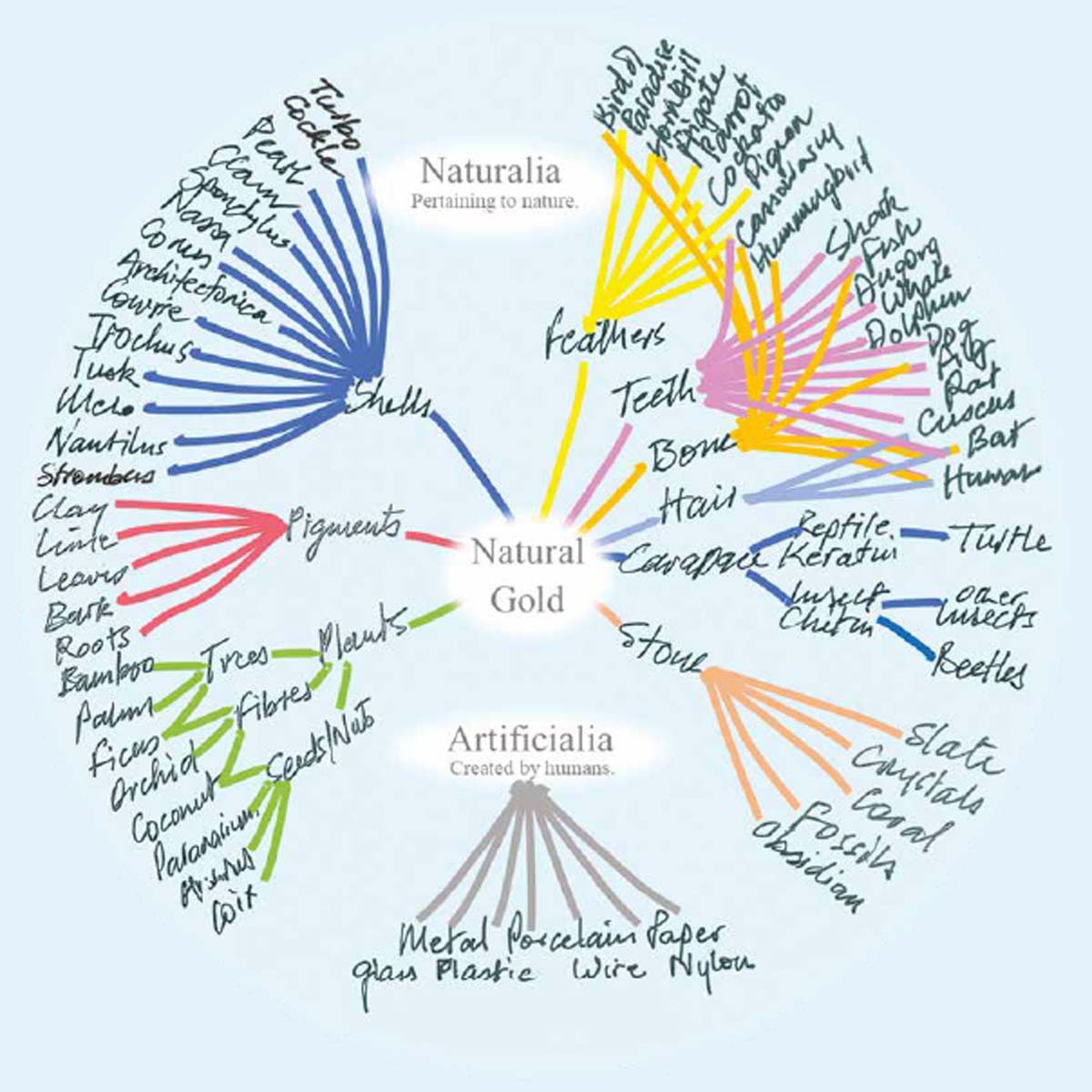
Chapter 2, ‘Natural Gold’ looks at the diversity the raw materials employed by Pacific peoples in the creation of their adornments. The materials covered are extensive, ranging from ‘naturalia’: shells, feathers, teeth, fur etc. to ‘artificialia’, like ceramic, glass, and plastics. Grulke incorporates natural history information here, using his marine diving experience to great effect.
Chapter 3, ‘Precious Objects’, addresses the transformation of value in a diversity of objects, from bilums to shell goods including Solomon Islands shell valuables, Kina and other pearl shell pectorals, ‘a plethora of rings’ and the ‘ubiquitous kapkaps’. Chapters 2 and 3 make up the main body and most successful part of the book, with potential for use as an object visual and natural history identificatory reference.
Chapter 4, ‘Value Networks’ includes case studies of Pacific trade and exchange networks and objects, highlighting some of the great trading voyages, notably the Massim-Kula system. There was an opportunity missed here, to consider and reflect on the role of contemporary non-Pacific private collectors in the market and movement of cultural artefacts.
In writing about Pacific adornment the author expresses genuine appreciation but acknowledges he is ‘an interloper’. Indigenous voices and perspectives are largely absent in the book. When included, they are sometimes anonymous, undated, or referenced in a way that makes them difficult to trace.
The book has inconsistent referencing overall and lacks a bibliography. The list of references provided via the book website is incomplete. Additional editing and fine tuning would have made a more reliable resource for research. Ultimately ADORNED is a visual feast and most informative and enjoyable from this perspective.