
by David Ferguson
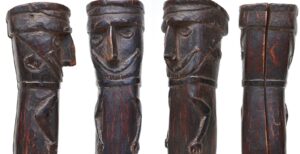
This article introduces a curious ‘in the round’ portrait carving of a European gentleman with carving conventions consistent to that of the Kiwai area; this novel carving is described and illustrated.
Introducing the Kiwai area
Newton (1961) described the ‘Kiwai area’ as a huge area, extending from the Torres Strait to the east bank of the Fly River Delta that contained art styles that originated from indigenous and newcomers’ cultures (Haddon 1932). From this area human figure carvings are generally small, used in ritual and are known in three forms: ‘in the round’, ‘board like front view’ and ‘board like side view’. In the literature fifteen ‘in the round’ human figures were cited previously by the author (2021) as having originated from the Torres Strait.
This new portrait carving is ‘in the round’ and wears a peaked hat with carving conventions consistent to the Kiwai area. Its early history is unknown though likely dates from the late 19th to early 20th century, and coincides with a period when numerous Europeans had descended into the Kiwai area for various reasons. This figure, which was purchased from an estate downsizing auction, is described and illustrated.
Detailed description
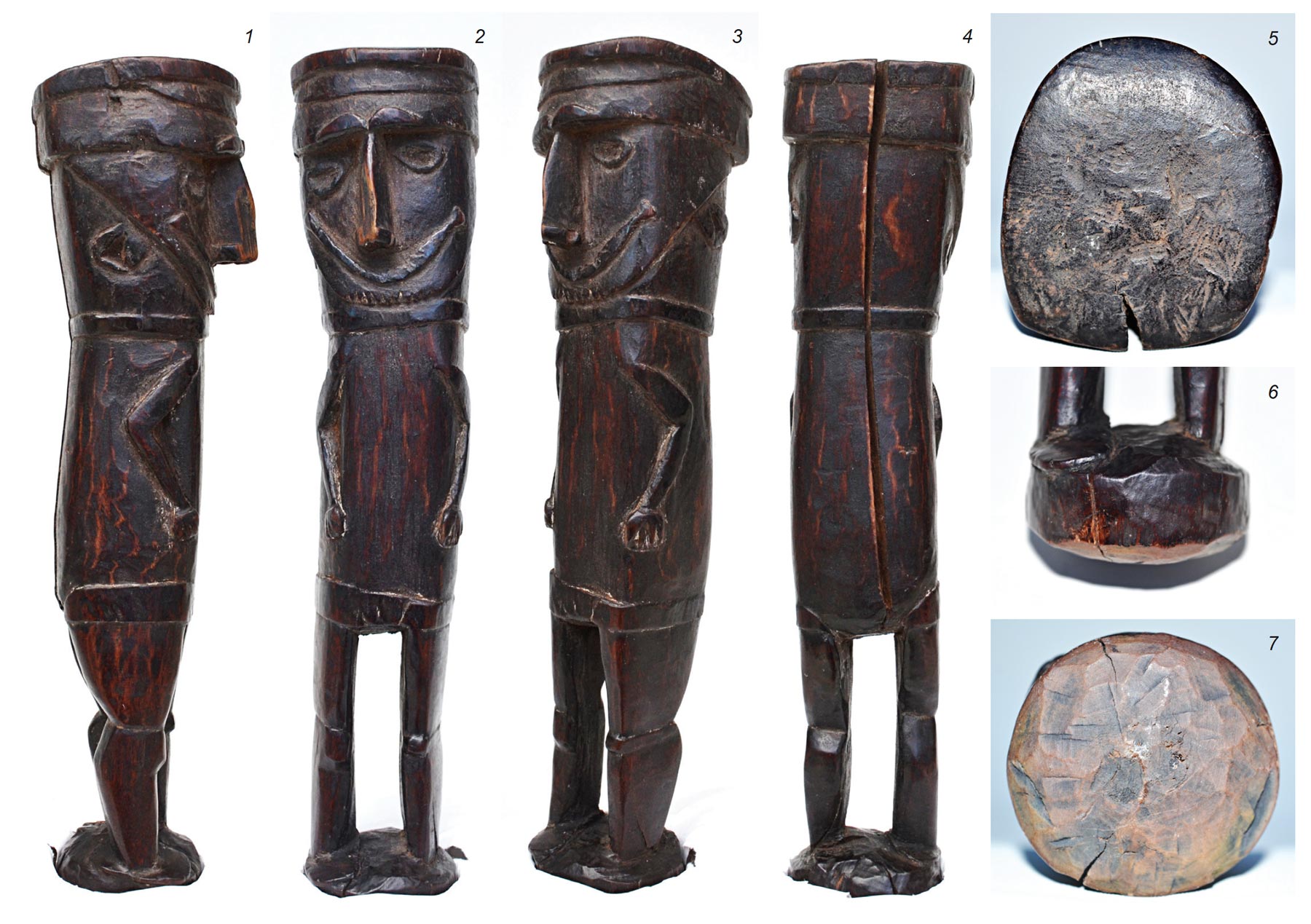
The carving has an old glossy well-handled patina; the torso is with a slight leaning to the left; head slightly tilted right; wearing a peaked hat with rim slightly wider than head, 5.0 x 5.7 cm; top surface relatively flat; frontal slightly down curved along front; frontal peak extends halfway down the forehead; prominent eyebrows either side of apex of nose, on eyebrow ridge that completely circumferences the head; eyes centrally area concave, margins as oval elevated ridges. The nose is proportionally large and long with distinct arch (with old surface damaged along right side) and with flared nostrils ridges; nostril ventral surface concave without pierced septum. The mouth is a widely extended ‘U’ shaped ridge; serrations on chin suggest beard hair; the chin extends to the back part of the head meeting extended to eyebrow ridge. The ears are elevated irregular oval-shaped, middle with irregular triangular excavation. A continuous narrow band or ‘collar’ encircles the neck.
The torso has a rounded rectangular form; arms bent at the elbows and hands carved in relief; lower waist with narrow elevated band or ‘belt’ ends terminating behind inner legs. Frontal view of legs widely separated, narrow; viewed laterally the upper and lower legs naturalistically defined; both knees with horizontal elevated ridges; right foot defined as oval pad, left foot without oval pad; figure height 21 cm; base short with round basal surface; 4cm diameter with the surface beneath with a newer patina (Fig. 6, 7) as though it was cut from a walking stick or staff.
Placing the carving in context
Europeans made their presence early into the Kiwai area; in 1848-49 Captain Owen Stanley, commander of H.M.S. Rattlesnake, explored the Torres Strait islands (Moore 1979). Pearl-shell was soon after discovered in the Torres Strait in 1860, bringing numerous people. In response the London Mission Society Ministers sent Ministries into the area. The Torres Strait was annexed as part of the British colony of Queensland in 1879 and soon after a team of anthropologists from Cambridge University undertook extensive studies of the Torres Strait Islanders led by Alfred C. Haddon with W. McDougall, C.S. Myers, S.H. Ray, W.R. Rivers, C.G. Seligman, and A. Wilkin. Soon after, Cambridge University then sent Gunner Landtman to study the populations of the islands of Fly River Delta and mainland coastal areas in the late 19th and early 20th century (Landtman 1927).
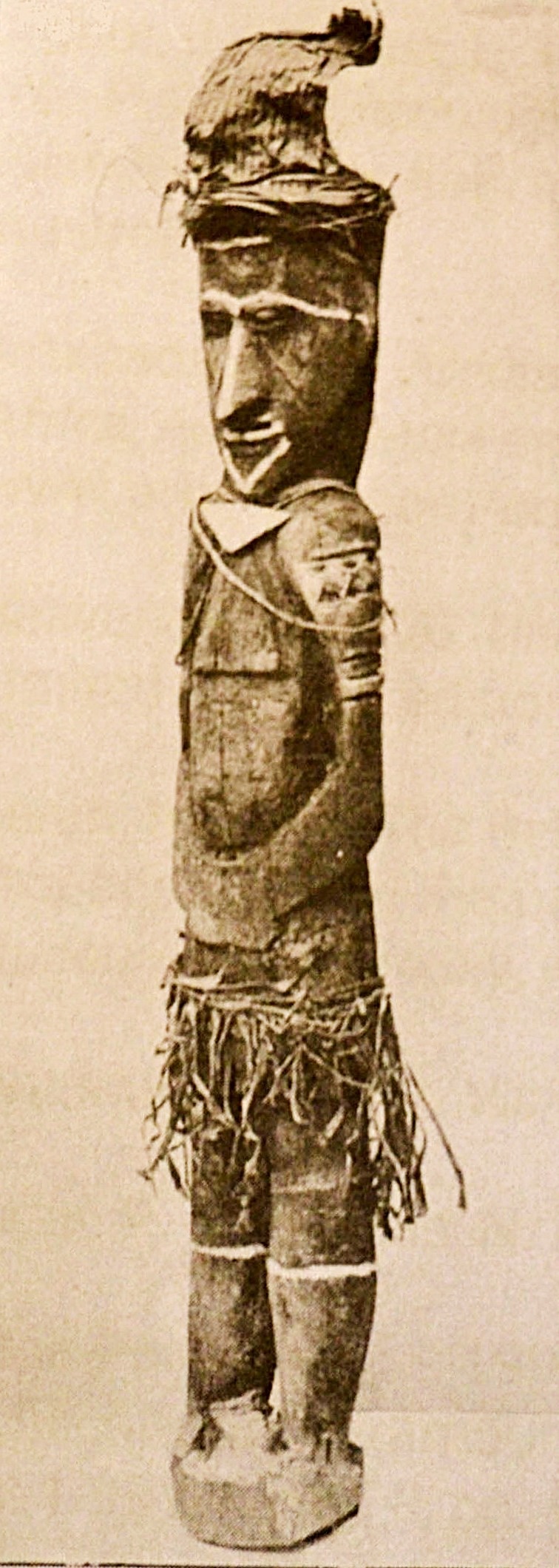
The portrait carving displays carving conventions consistent to the ‘Kiwai area’, these include its stance, distinctive eyebrows and large ridged nose that’s without a pierced septum. A similar sculpture published in Haddon (1932) originated from Mabuiag Island (Jarvis Is) with the name madub (Fig. 8) displaying similar carving conventions.
The carved person represented would have stood apart from all others likely by being considerate and observant of others, unlike other outsiders; that at that time were more intent on acquiring tradable resources.
References
Ferguson, D. 2021. An important addition to the sculptures known from the Kiwai area. Journal of the Oceanic Art Society Vol. 26: No.1.
Haddon, A.C. 1901. Reports of the Cambridge Anthropological Expedition to Torres Strait, Volume V.
Haddon, A.C. 1932. Head-Hunters Black, White, and Brown. The Thinker’s Library, No. 26 London: Watts & Co.
Landtman, G. 1927. The Kiwai Papuans of British New Guinea: MacMillian and Co., Limited St. Martin’s Street, London.
Moore, D.R. 1979. Islanders and Aborigines at Cape York; Australian Institute of Aboriginal Studies Canberra: Humanities Press Inc, New Jersey, U.S.A.
Newton, D. 1961. Art Styles of the Papuan Gulf. New York: The Museum of Primitive Art.
Disclaimer: Though the author is associated with CSIRO the object and opinions expressed are those of the author.
Caption: Figure 8. Wooden model of a madub from Mabuiag Island (Jarvis Is), Cambridge Museum height 76cm. Image from Haddon Vol.5 pl. XX. Fig4. Image created and provided by Document Supply Services, National Library of Australia.